


Your shopping cart is empty!
Spinach "Matador 30"
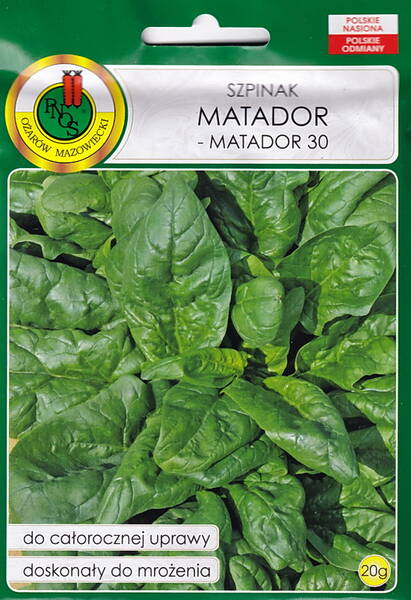
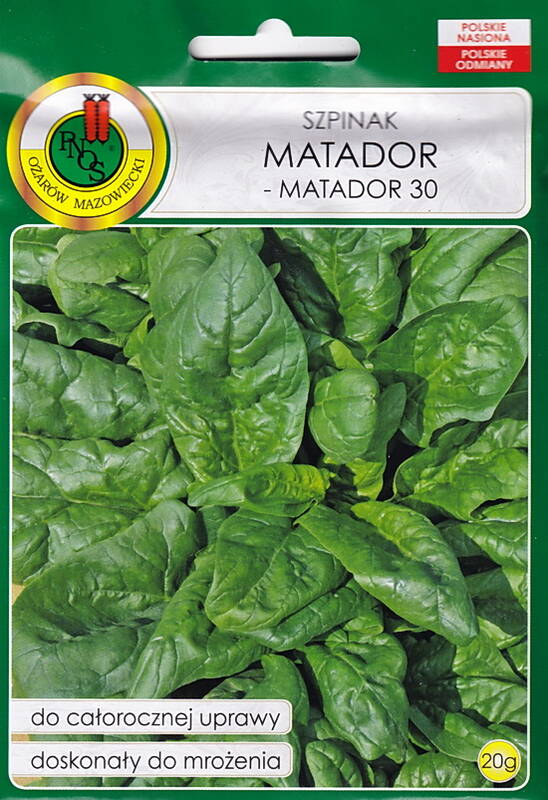
Spinach "Matador 30".
Compact and vitamin-rich.
Mid-early variety: 40-50 days from full germination to technical maturity. Characterized by a high content of mineral substances, protein, and vitamins. The leaf rosette is compact, pressed to the ground, 14-19 cm in diameter. Leaves are dark green, round, dense, with a bubbly and corrugated surface.
The variety requires abundant watering but is valued for its resistance to bolting and low temperatures. Yield - 2.5-2.8 kg/m².
The variety is resistant to stalk formation, relatively resistant to diseases and pests. Rosette leaves are used for preparing fresh salads, green soups, sauces, and garnishes.
Cultivation.
Spinach is grown by sowing seeds in the ground in several terms: from early spring to summer, in autumn, and before winter. It overwinters well in the rosette phase under snow. Sowing depth 1-2 cm. To accelerate the emergence of seedlings, seeds are soaked for 1-2 days in water at a temperature of +18°C, changing it periodically. The optimal temperature for plant growth is +15°C.
Spinach harvesting begins in the phase of a rosette of 5-8 leaves and before the appearance of flowering shoots.
Sowing: April - August.
Transplanting: April (2nd, 3rd decade) – August.
Harvesting: May – September.
Spinach is a cold-resistant crop; sowing in open ground is carried out at the earliest dates (late April – early May) to a depth of 1.5-2 cm. The culture is demanding of soil fertility and moisture. High temperature causes bolting, and a short day delays leaf development. Therefore, sowing in May - early June, or closer to autumn, is most optimal. Seeding rate 3-4 g/m², seeding depth 2-3 cm. Row spacing 25-30 cm. Distance between plants after thinning (in the phase of two true leaves) - 10 cm.
Harvesting is carried out selectively, repeatedly, before flowering begins. High summer temperatures force the plant to bolt, so repeated sowing is recommended only in early August.
* Super early harvest.
Sow spinach seeds in mid-August and cover the crops with covering material. Water if necessary. By the end of the season, spinach will form decent rosettes. It is advisable to leave the covering material for the winter. Plants in the rosette phase overwinter calmly under the snow.
In early spring, immediately after the snow melts, the plants will wake up and begin to grow rapidly. 7-10 days after the snow melts, you will already be able to harvest.
This option involves the usual sowing of plants in open ground. But spinach seeds germinate with difficulty, so it is wiser to soak them first in sawdust: place a container with moist sawdust in an open plastic bag and put it in a warm place, and after a week plant the sprouted seeds.
Plant one seed from another at a distance of 8-10 cm, because with dense planting you risk under-harvesting. The distance between rows is at least 15 cm.
A few words about soil. Spinach prefers fertile neutral soils. On poor soils, plants grow weak, light yellow in colour, and produce few leaves. Therefore, build a high bed, in the lower layer of which there should be organic residues accumulated since spring (do not put them in a compost heap, but on the future spinach bed). It is not bad to add fresh or semi-rotted manure. If you use fresh manure, then to prevent the accumulation of nitrates in plants, sprinkle a two-centimetre layer of sawdust and a layer of some organic residues over it. Add ordinary fertile soil on top. Spinach grows so fast (ready in 30-40 days) that it can be sown several times during the summer.
Compact and vitamin-rich.
Mid-early variety: 40-50 days from full germination to technical maturity. Characterized by a high content of mineral substances, protein, and vitamins. The leaf rosette is compact, pressed to the ground, 14-19 cm in diameter. Leaves are dark green, round, dense, with a bubbly and corrugated surface.
The variety requires abundant watering but is valued for its resistance to bolting and low temperatures. Yield - 2.5-2.8 kg/m².
The variety is resistant to stalk formation, relatively resistant to diseases and pests. Rosette leaves are used for preparing fresh salads, green soups, sauces, and garnishes.
Cultivation.
Spinach is grown by sowing seeds in the ground in several terms: from early spring to summer, in autumn, and before winter. It overwinters well in the rosette phase under snow. Sowing depth 1-2 cm. To accelerate the emergence of seedlings, seeds are soaked for 1-2 days in water at a temperature of +18°C, changing it periodically. The optimal temperature for plant growth is +15°C.
Spinach harvesting begins in the phase of a rosette of 5-8 leaves and before the appearance of flowering shoots.
Sowing: April - August.
Transplanting: April (2nd, 3rd decade) – August.
Harvesting: May – September.
Spinach is a cold-resistant crop; sowing in open ground is carried out at the earliest dates (late April – early May) to a depth of 1.5-2 cm. The culture is demanding of soil fertility and moisture. High temperature causes bolting, and a short day delays leaf development. Therefore, sowing in May - early June, or closer to autumn, is most optimal. Seeding rate 3-4 g/m², seeding depth 2-3 cm. Row spacing 25-30 cm. Distance between plants after thinning (in the phase of two true leaves) - 10 cm.
Harvesting is carried out selectively, repeatedly, before flowering begins. High summer temperatures force the plant to bolt, so repeated sowing is recommended only in early August.
* Super early harvest.
Sow spinach seeds in mid-August and cover the crops with covering material. Water if necessary. By the end of the season, spinach will form decent rosettes. It is advisable to leave the covering material for the winter. Plants in the rosette phase overwinter calmly under the snow.
In early spring, immediately after the snow melts, the plants will wake up and begin to grow rapidly. 7-10 days after the snow melts, you will already be able to harvest.
This option involves the usual sowing of plants in open ground. But spinach seeds germinate with difficulty, so it is wiser to soak them first in sawdust: place a container with moist sawdust in an open plastic bag and put it in a warm place, and after a week plant the sprouted seeds.
Plant one seed from another at a distance of 8-10 cm, because with dense planting you risk under-harvesting. The distance between rows is at least 15 cm.
A few words about soil. Spinach prefers fertile neutral soils. On poor soils, plants grow weak, light yellow in colour, and produce few leaves. Therefore, build a high bed, in the lower layer of which there should be organic residues accumulated since spring (do not put them in a compost heap, but on the future spinach bed). It is not bad to add fresh or semi-rotted manure. If you use fresh manure, then to prevent the accumulation of nitrates in plants, sprinkle a two-centimetre layer of sawdust and a layer of some organic residues over it. Add ordinary fertile soil on top. Spinach grows so fast (ready in 30-40 days) that it can be sown several times during the summer.
* The homeland of spinach is Asia (Ancient Persia, modern Iran). From there, two centuries BC, it was brought to China. Spinach was mainly cultivated in Asian countries and was very popular among Arabs. No information about the cultivation of spinach by the ancient Greeks or Romans has been preserved.
Spinach leaves are very rich in proteins (up to 34% in dry matter), carbohydrates, contain large amounts of vitamins C (37-72 mg/100g), B1, B2, carotene (up to 4 mg/100g), as well as iron and phosphorus salts. In addition, spinach contains vitamins K, P, E and salts of potassium, calcium, magnesium, and iodine.
Young spinach leaves are consumed both raw and boiled or stewed, and, of course, canned. The most useful are fresh leaves in raw form (they store quite well at a temperature of -1-2 degrees Celsius and do not spoil for up to 3 months), salads are prepared from them, juice is squeezed.
Spinach juice is a very useful dietary product, as well as a good natural dye.
The most common spinach dishes are soups, purees, and green soups.
Washed spinach spoils quickly, so it should be washed immediately before use. Spinach is boiled in salted water for 7-10 minutes. To keep the colour during cooking, spinach should be boiled in an open pot in a large amount of water (3-4 litres per 1 kg of spinach) with vigorous boiling. Do not stew spinach together with sorrel, as spinach changes colour and becomes coarse.
Did you know that... if you are going to a picnic or party, take bunches of spinach with you, following the example of the ancient Egyptians. Before the feast, they ate it in large quantities so that their heads would remain clear, despite the abundance of drinks served. Scientific studies have confirmed: a special set of components and fibre included in spinach slow down the absorption of alcohol into the blood and quickly remove it from the body.